Deep beneath the sun-baked sands of Egypt, a perplexing marvel challenges our understanding of ancient engineering – the enigmatic Saqqara Serapeum. Imagine colossal granite boxes, each weighing tons, resting in narrow underground passageways defying conventional logic. This isn’t just remarkable engineering; it defies the boundaries of what was deemed possible in ancient times.
What baffles engineers is the mystery of how these immense stone boxes were transported through tunnels so constricted that traditional methods, such as wheel mechanisms or known lifting equipment, seem implausible. Moreover, the tunnel floors show no evidence of the means used to maneuver these colossal objects – no imprints from sleds, no traces of wheel tracks; it’s as if these mammoth stone blocks mysteriously glided into position.
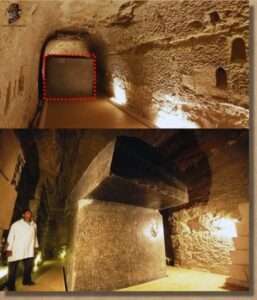
The precision exhibited in crafting these boxes is truly mesmerizing. Each one boasts a margin of error less than a millimeter – a level of accuracy that would pose a challenge even for modern-day machinery. However, the few hieroglyphs adorning them appear amateurish and inaccurate, starkly contrasting with the exquisite engineering marvel before them; it’s akin to finding crude sketches on a meticulously designed spacecraft.
Adding to the intrigue is the darkness shrouding the tunnels, forming an underground labyrinth where even modern lighting struggles to penetrate. Yet, the walls reveal no remnants of ancient torch smoke. How did the builders achieve such flawless precision in absolute darkness?
Most compelling of all is the juxtaposition between flawless engineering and amateurish hieroglyphs, hinting at the presence of two distinct civilizations – one equipped with technology beyond our comprehension and another attempting to lay claim to it with fumbling hieroglyphs.
The Saqqara Serapeum stands as a testament to something extraordinary: a civilization predating ancient Egypt, possessing engineering prowess that continues to baffle us today. Their legacy is etched in these impeccably crafted stones, challenging us to unravel the enigma of how they accomplished what was once deemed unachievable.
In conclusion, the Saqqara Serapeum stands as a silent sentinel of a bygone era, whispering secrets of a civilization that remains a mystery yet holds a wealth of knowledge waiting to be unearthed.
